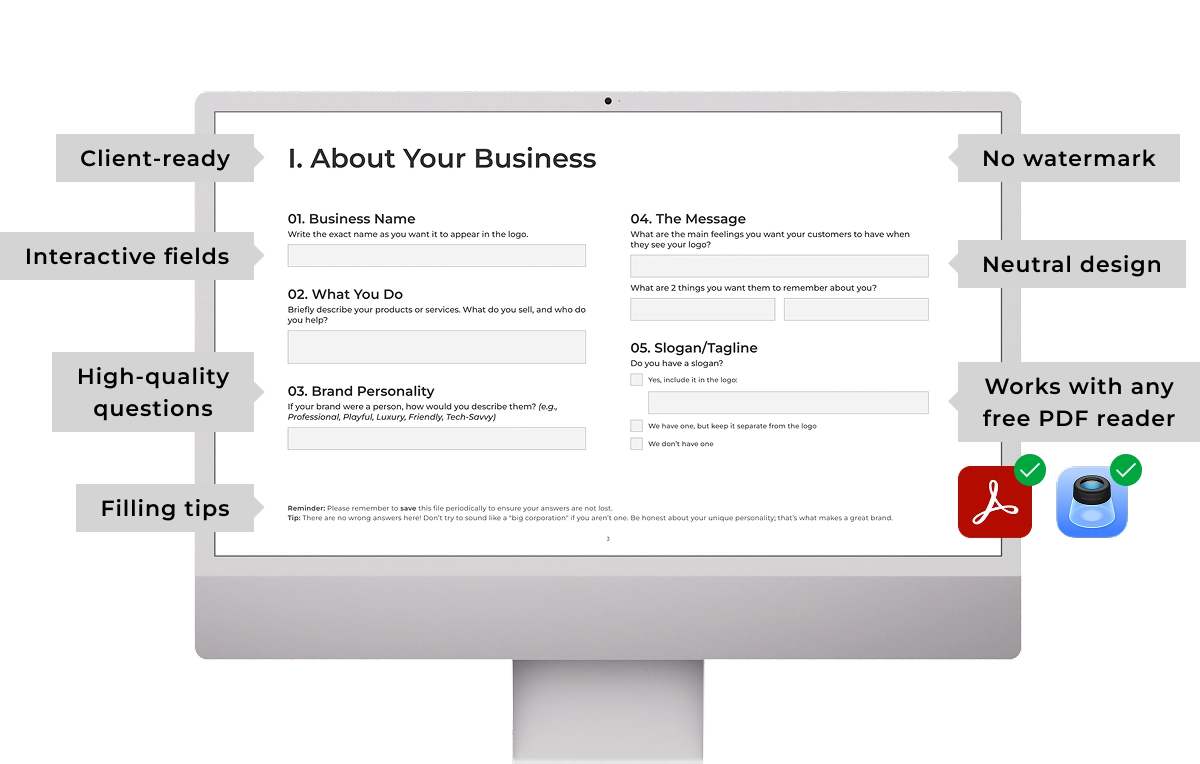





Jumping into a low-budget logo project without a solid brief is a recipe for endless revisions. You dive into your design software, hoping to find the answer through iteration, and suddenly you are on round seven of unpaid feedback. Every extra unpaid minute eats directly into your project margins.
Sending a messy text document usually results in clients hating the process. You end up with half-empty answers, confusing emails, and a lot of guesswork.
You do not need a complicated client portal; you need a simple tool that your clients will actually use. Here are the 15 questions you must ask to eliminate the "fix-it-later" cycle.
I. Uncover the business reality
Before you draw a single sketch, you need to understand the foundation. Do not just list questions; use them strategically to extract the core of the business.
1. Business name: Ask for the exact name. This prevents embarrassing late-stage typos.
2. What they do: Different industries have different baseline expectations. Knowing their exact service dictates your visual language.
3. Brand personality: Force the client to think about their brand as a living entity, rather than just a graphic.
4. Desired feeling: Knowing the feeling they are looking for will save you hours of blind exploration.
5. Top two takeaways: Narrow the focus. Asking for the two main things customers should remember gives you a clear anchor for your design.
6. Slogan: Find out if a tagline needs to be integrated, and mine it for deeper insights into their core message.
II. Map the battlefield
A logo does not live in a vacuum. It has to compete. You need to extract the client's strategic edge.
7. Target audience: Ensure you are designing for the market, not just the client's ego.
8. Top competitors: Identify the visual baseline of their industry so you can design an identity that outperforms it.
9. Visual differentiation: Find out what they like or dislike about their competitors' logos to generate a clear list of design dos and don'ts.
10. Why customers choose them: Pinpoint their unique selling proposition.
III. Set visual boundaries
This is the cure for the dreaded "I will know it when I see it" syndrome.
11. Icons and imagery: Extract any preconceived ideas early so you do not waste time sketching in the wrong direction.
12. Color preferences: Lock in constraints. Ask for exact hex codes if they have them, or note the specific colors they absolutely hate.
13. Primary usage: Know exactly where the logo will live. This will dictate your technical format: horizontal or stacked.
14. Inspiration links: Get a visual baseline and stop subjective guesswork before it starts by asking them to show you what they like.
15. Final catch-all: Make sure they do not have any lingering files, brand history, or details that were not covered by the previous questions.
A hands-off brief that works for you
Now that you know what to ask, you have to address the execution problem. You cannot afford to spend hours on calls trying to extract this information.
To solve this, I created a 6-page interactive PDF. It is incredibly user-friendly and gently walks your client through the 15 questions, making them feel taken care of while protecting your time. They fill it in, save it, and send it back.
Don’t chase clients for details
Get a professional, comprehensive, client-ready brief that works in any free PDF reader.